3D-QSAR
Simplify Drug Design

Ozan Dundar Agirdi Yarasi

Ozan Dundar Agirdi Yarasi Access

"Ağırdı Yarası" reflects the listener's own sorrows. Ozan Dündar shows that there is shared humanity in acknowledging pain. By expressing this pain, he provides catharsis. The ancient voice of the ozan remains relevant.

Ozan Dündar connects generations. His compositions are rooted in the türkü (folk song) structure. "Ağırdı Yarası" captures the "melancholy of the soul" ( hüzün ) central to Turkish culture. It is about the dignity of bearing burdens. Conclusion Ozan Dundar Agirdi Yarasi

"Ağırdı Yarası" ("His/Her Wound Was Heavy") by Ozan Dündar is an example of contemporary Turkish folk poetry ( halk şiiri ). It explores emotional endurance, unrequited longing, and the weight of "spiritual wounds." Dündar blends the traditions of the Anatolian ozan (bard) with a modern perspective. The Significance of the "Wound" "Ağırdı Yarası" reflects the listener's own sorrows

The title suggests a focus on pain. In Turkish folk music, a "wound" ( yara ) often represents scars from love, betrayal, or life's burdens. Dündar's lyrics suggest some pains become permanent parts of one's identity. Lyrical Simplicity The ancient voice of the ozan remains relevant

The piece uses simple language to express complex truths. The "heaviness" in the poem refers to the psychological impact of grief. The pain can slow life's pace.

The imagery includes the natural world, such as mountains, dust, and roads. These are common in the ozan tradition and connect the emotion to the physical landscape of Anatolia. Connection to Tradition

More information about the or biographical info on Ozan Dündar is available.

Ozan Dundar Agirdi Yarasi

"Ağırdı Yarası" reflects the listener's own sorrows. Ozan Dündar shows that there is shared humanity in acknowledging pain. By expressing this pain, he provides catharsis. The ancient voice of the ozan remains relevant.

Ozan Dündar connects generations. His compositions are rooted in the türkü (folk song) structure. "Ağırdı Yarası" captures the "melancholy of the soul" ( hüzün ) central to Turkish culture. It is about the dignity of bearing burdens. Conclusion

"Ağırdı Yarası" ("His/Her Wound Was Heavy") by Ozan Dündar is an example of contemporary Turkish folk poetry ( halk şiiri ). It explores emotional endurance, unrequited longing, and the weight of "spiritual wounds." Dündar blends the traditions of the Anatolian ozan (bard) with a modern perspective. The Significance of the "Wound"

The title suggests a focus on pain. In Turkish folk music, a "wound" ( yara ) often represents scars from love, betrayal, or life's burdens. Dündar's lyrics suggest some pains become permanent parts of one's identity. Lyrical Simplicity

The piece uses simple language to express complex truths. The "heaviness" in the poem refers to the psychological impact of grief. The pain can slow life's pace.

The imagery includes the natural world, such as mountains, dust, and roads. These are common in the ozan tradition and connect the emotion to the physical landscape of Anatolia. Connection to Tradition

More information about the or biographical info on Ozan Dündar is available.
welcome to 3D-QSAR.com

Fast Molecule Management

Welcome to the first web application for Pharmaceutical Chemistry. 3D-QSAR.com offers user friendly and advanced tools for developing either ligand-based or structure-based 3D QSAR models and performing common useful operations over dataset of molecules.

Sign Up Know More
welcome to 3D-QSAR.com

Explore New Technologies

Our research team is always exploring new technologies and offering them as new products for you to use. Graph Neural Networks (GCNs) are a promising new frontier for Chemistry models development and we are working right now to make them part of the tools available to you.

Read More

Applications

Click on any button to start using the platform. If you want to know a bit more about the application, visit the link below to see all you will be able to do.

Explore Apps
In silico local QSAR modeling of bioconcentration factor of organophosphate pesticides Purusottam Banjare, Balaji Matore, Jagadish Singh, Partha Pratim Roy In Silico Pharmacology Evaluation of molecular structure based descriptors for the prediction of pEC50(M) for the selective adenosine A2A Receptor Nilima Rani Das, Sneha Prabha Mishra, P. Ganga RajuAchary Journal of Molecular Structure Alkylated monoterpene indole alkaloid derivatives as potent P-glycoprotein inhibitors in resistant cancer cells David S P Cardoso, Annamária Kincses, Márta Nové, Gabriella Spengler, Silva Mulhovo, João Aires-de-Sousa, Daniel J V A Dos Santos, Maria-José U Ferreira European Journal of Medicinal Chemistry Computational Studies of 3D-QSAR on a Highly Active Series of Naturally Occurring Nonnucleoside Inhibitors of HIV-1 RT (NNRTI) Waqar Hussain, Arshia Majeed, Ammara Akhtar and Nouman Rasool Journal of Computational Biophysics and Chemistry

A Valuable Tool

We are at the beginning of our journey but our work is already being recognized. These are the projects that mention 3D-QSAR.com as a valuable resource for their results and have been empowered with our tools. We thank you greatly.

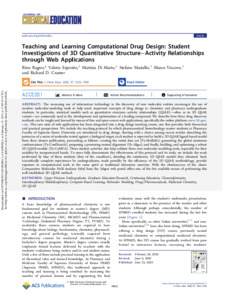
Paper: Teaching and learning computational
                              drug design: Studenti Investigations of 3D
                              Quantitative Structure–Activity Relationship
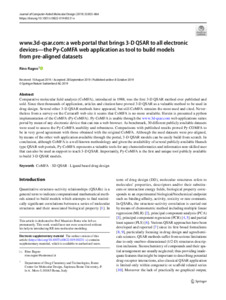
                              through Web Applications. Teaching and Learning Computational Drug Design... Journal of Chemical Education Paper: www.3d-qsar.com a web portal that brings
                              3-D QSAR to all electronic devices. the Py-CoMFA
                              web application as tool to build models from
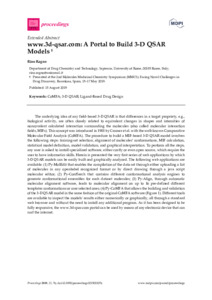
                              pre-aligned datasets. www.3d-qsar.com: a web portal that brings 3-D QSAR to all... Journal of Computer-Aided Molecular Design Paper: a portal to build 3-D QSAR Models. A Portal to Build 3-D QSAR Models. Proceedings

Reference Our Work

3D-QSAR.com is the result of an effort of our research team to offer valuable and easily accessible tools for the development of new active molecules. Cite our work by clicking on the pages or contact us directly.

Contact Us